
- Revenue Secretary Sanjay Malhotra has been appointed as the new Governor of the Reserve Bank of India (RBI) by the Union Cabinet. He succeeds Shaktikanta Das, who will end his term on December 10, 2024. He is an Indian Administrative Service (IAS) officer of the 1990 batch of the Rajasthan cadre.
- SM Krishna, former External Affairs Minister and Karnataka Chief Minister, passed away at 92 years old on December 9, 1932. SM Krishna was born on May 1, 1932 in Somanahalli in the Mandya district of Karnataka. He graduated from Maharaja College, Mysore and then completed LLB from Government Law College.
- Former Puducherry Chief Minister M. D. R. Ramachandran passed away on 9 December.
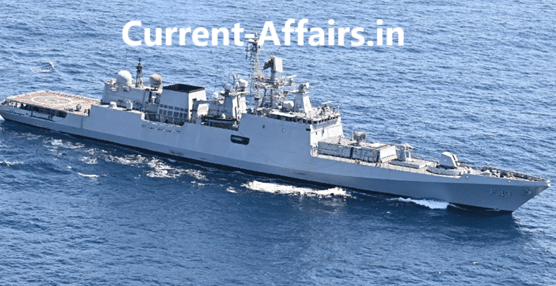
- A new warship ‘INS Tushil’ was commissioned in the Indian Navy.
- Aarith Kapil, a Delhi-based chess player, has become the first Indian to defeat a 66-year-old Grandmaster at the age of 9. he defeated American Grandmaster Rased Ziyatdinov, who is 57 years older.
- The International Cricket Council (ICC) has banned the US National Cricket League (NLC).
- Today’s History: Human Rights Day is celebrated every year on December 10. This is the day when the United Nations General Assembly adopted the Universal Declaration of Human Rights (UDHR) in 1948. In 1950, the UN officially declared this day as Human Rights Day. On this day in 1958, America’s first domestic jet passenger flight, a Boeing 707, took off from New York to Miami. There were 111 passengers on board the two-and-a-half-hour flight. In1868, this day, the world’s first traffic light was installed in London. In 1896, the great scientist Alfred Nobel, who discovered dynamite, passed away today.
INS Tushil Commissioned into the Indian Navy
The Indian Navy has officially commissioned its latest advanced warship, INS Tushil, on December 9, 2024. This warship is an advanced stealth-class missile frigate. INS Tushil has launched several advanced missiles, with a large number of indigenous missiles deployed.
Key Features and Specifications of INS Tushil
1. Advanced Weapon Systems
INS Tushil is equipped with state-of-the-art weaponry to address modern combat challenges:
- BrahMos Supersonic Cruise Missiles for long-range precision strikes.
- Surface-to-Air High-Range Missiles to counter aerial threats.
- Anti-aircraft guns for enhanced air defense.
- Controlled Close-Range Rapid-Fire Gun System for high-intensity combat.
- Torpedoes and Rockets designed for anti-submarine warfare.
2. Stealth and Stability
The ship’s design incorporates advanced stealth technology, enabling it to avoid detection by radar systems. Its enhanced stability ensures superior maneuverability and performance in diverse maritime conditions.
3. Technical Specifications
- Displacement: 3,850 tons
- Length: 409.5 feet
- Beam: 49.10 feet
- Draught: 13.9 feet
- Speed: Maximum of 59 km/h
- Endurance: Capable of operating at sea for up to 30 days, accommodating 18 officers and 180 sailors.
India-Russia Partnership in Defense
INS Tushil is part of a $2.5 billion defense agreement between India and Russia, signed in 2016. Under this deal:
- Two stealth frigates are being constructed in Russia at the Yantar Shipyard.
- Two additional frigates will be built in Goa Shipyard, India.
- The second warship, INS Tamal, is scheduled for delivery by mid-2025.
Background of INS Tushil
The ship was launched in October 2021 at Russia’s Yantar Shipyard in the presence of India’s then-Ambassador to Russia, D. Bala Venkatesh Varma, and senior naval officials. It was named “Tushil” by Datla Vidya Varma, symbolizing its Sanskrit meaning: “impenetrable shield”.
Frigate vs. Destroyer: A Comparison
There are mainly two types of warships – frigates and destroyers. INS Tushil belongs to the Frigate category of warships, designed for versatility and speed:
- Frigates: Smaller, agile vessels focused on anti-surface, anti-aircraft, and anti-submarine operations.
- Destroyers: Larger, more heavily armed, specializing in eliminating major enemy vessels such as aircraft carriers.
INS Tushil’s commissioning underscores India’s growing naval strength and commitment to safeguarding its maritime interests. Its advanced features and collaborative development with Russia make it a strategic asset, enhancing India’s position as a dominant maritime force.